The Direct Answer
Navigating Minimum Order Quantities (MOQs) is one of the biggest challenges for growing water sports brands, rental businesses and resort operators. SUPsfactory believes high quality and custom branding should be accessible to businesses of all sizes. Our standard manufacturing MOQ is built from raw material roll lengths, and our flexible co-branding program makes small-batch ordering effortless — from as few as 5–10 boards, with a transparent, upfront fee structure.
How Our Standard MOQ Works — Built from Raw Materials
In the manufacturing of high-grade inflatable stand-up paddleboards (SUPs), production runs are determined by the raw drop-stitch material roll lengths.
- The baseline: the minimum standard production run for raw drop-stitch fabric is 150 meters.
- The yield: a full 150-meter roll translates to approximately 90–100 paddleboards.
This standard MOQ ensures optimal material utilization and structural consistency across full factory runs. It is the volume tier that makes full-brand printing, packaging and mould investment workable for both sides — but it is not the only way to get your brand on a board.
Co-Branding for Small-Batch Orders
Recognizing that many clubs, boutique outlets and rental hubs require smaller initial orders, we offer a low-barrier co-branding program built on our latest annual product collections:
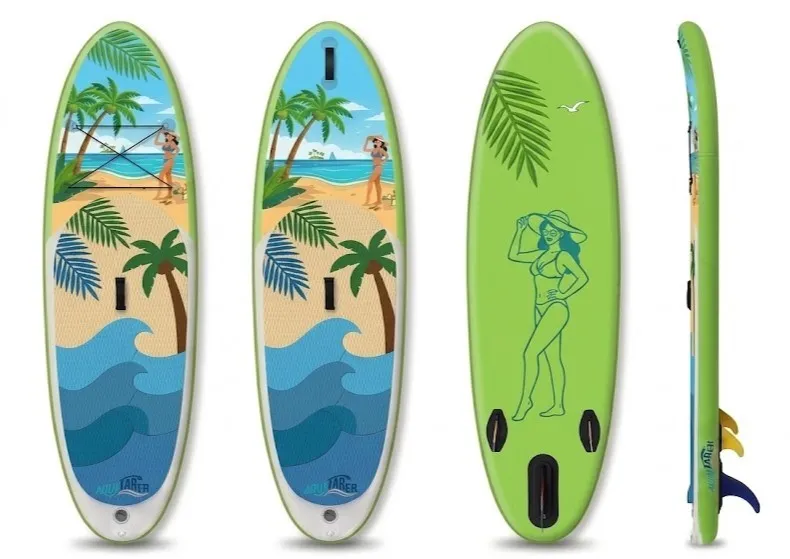
- Fixed shell & shape specs — each model retains its field-tested hull geometry, board dimensions and core engineering specifications across all annual designs. Your boards ship with the same proven construction as our full-volume production.
- Primary brand identification — our manufacturer brand occupies the main central visual section of the board, keeping the program honest and consistent across orders.
- Custom secondary branding — your brand or company logo is screen-printed on secondary accent positions, such as near the board's nose or along the side rail.
Whether you are launching a new rental station, testing local market demand or validating a product line before committing to volume, co-branding lets you offer professionally customized SUPs without heavy inventory pressure.
Transparent Customization Fee Structure
To ensure complete cost predictability, custom screen-printing options are priced with clear, upfront rates:
| Item | Rate | | --- | --- | | Screen-printing mould fee, logo up to 30 cm (one-time setup per logo size) | $10 USD | | Screen-printing mould fee, logo up to 50 cm (one-time setup per logo size) | $15 USD | | Factory handling & printing fee | $1 USD per board |
The screen-printing mould fee is a one-time setup cost per logo size; the handling and printing fee applies per board. Rates are confirmed in the quotation for the current production cycle.
When to Choose Co-Branding vs. Full Private Label
- Co-branding (5–10 pcs) — validate the market with your logo on a proven platform at a low MOQ. Our brand holds the primary position; your logo occupies the secondary positions.
- Pilot batch (20–50 pcs) — near-production pricing on a standard platform; the first run where your packaging, artwork and supply chain are validated end to end.
- Standard volume (90–100+ pcs per 150 m roll) — the entry point for a fully branded line: your logo, colors and packaging across the board, and custom-mould shapes become viable at this tier.
A complete breakdown of the pricing model — the tiers, the six cost drivers and five ways to reduce cost without cutting quality — is in How SUP OEM MOQ and Pricing Work.
FAQ
What is the minimum quantity for co-branding? Co-branding starts at 5–10 pcs on standard platforms from our annual collections. It is the lowest-volume way to put your logo on a factory-produced inflatable SUP.
Can I co-brand on any board model? Co-branding applies to the models in our current annual collections with fixed shell and shape specs. Full custom shapes and full-board graphics are handled through the standard-volume private-label route.
Do co-branding boards keep the same quality as volume production? Yes — co-branding uses the same construction, the same 7-stage quality-control nodes and the same inspection records as any volume run. Only the branding position differs.
Can I move from co-branding to private label later? Yes. Co-branding is designed as the entry point: validate the market, then scale to pilot and volume tiers where your brand takes the primary position and custom packaging applies.
Keep Reading
- How SUP OEM MOQ and Pricing Work — What a Custom Board Really Costs
- Custom SUP MOQ & Lead Time — From 1 Sample to Container-Scale Runs
- Launch Your SUP Brand with a Low-MOQ Trial Order
- Private Label vs OEM SUP — Cost, MOQ & Lead Time
- How to Choose a Reliable SUP OEM Manufacturer
- Custom SUP Product Development — From Concept to Container
Related Reading
2026-08-16
Quality Records to Audit at an SUP OEM Factory: The 14 Checkpoints That Separate Real Systems from Paper
Which quality records a serious buyer inspects at an inflatable SUP OEM factory — from QIP and IQC lots to air-tightness logs, NCR closure and calibration registers, with the reverse-traceability drill.
2026-08-16
Sample vs Trial vs Mass Production for SUP Orders: When to Use Each
Sample, trial and mass production SUP orders compared: typical quantities, lead times and price ranges, and how to pick the right order stage for your business.
2026-08-14
Private Label SUP: The Complete Step-by-Step Guide for New Brands
The full private-label SUP journey for new brands: choosing a factory, specifications, sampling, MOQ, compliance documents and launch timeline.
Need this built under your own brand?
Tell us your project and we reply with MOQ, sample timing and lead times for your market — no commitment.